October 2026 Market Update
Higher Yields, Steady Earnings
The third quarter was a bumpy one, with rising interest rates and stubborn inflation pulling markets in different directions. Here’s what we’re keeping an eye on as we head into the final stretch of 2026.
A Volatile Third Quarter
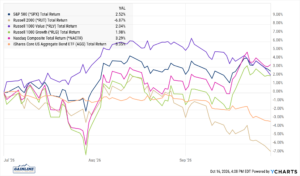
Q3 had its share of ups and downs. Large-company stocks finished with modest gains, helped along by value stocks and continued strength in AI-related companies: the S&P 500 returned 2.3% for the quarter. Smaller companies didn’t fare as well. The small-cap Russell 2000 fell 7.2%, as rising interest rates made borrowing more expensive, which tends to hit smaller businesses harder than larger ones.
Inflation rose 3.7% over the past year, according to the Bureau of Labor Statistics, well above the Federal Reserve’s 2% target. Higher gasoline prices drove more than half of September’s increase, and housing costs are still climbing.
In September, the Fed raised its policy rate by a quarter point to a range of 3.75%–4.00%, its first increase since July 2023 (Federal Reserve).
Stock Prices Are Being Measured Against Next Year’s Profits
The stock market tends to look about six months ahead. So right now, investors are paying more attention to what companies are expected to earn in 2027 than to what they’re earning today.
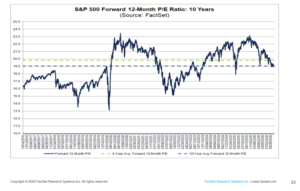
One common way to gauge whether stocks are expensive is the price-to-earnings (P/E) ratio, which compares a stock’s price to the company’s profits. Based on expected profits over the next year, the S&P 500 trades at about 19.1 times earnings, according to FactSet as of October 9. That’s right in line with its 10-year average and down from 20.4 at the end of June.
Analysts are expecting strong growth in both profits and sales next year, which is a big part of why those numbers sit where they do.
Technology stocks have actually gotten less expensive by this measure. The tech sector trades at about 19.2 times expected 2027 earnings, according to Bloomberg. Tech companies are projected to grow their profits faster than most other parts of the market, and when profits are expected to grow quickly, the P/E ratio comes down even if the stock price stays the same. That’s why tech’s ratio sits so close to the overall market’s, even with a stronger growth outlook.
This connects to something we talked about back in May. Earnings have been the steady part of this market, and AI continues to separate the companies that can turn it into real profits from the ones that can’t.
More Trading Is Going Into Rising Stocks
Another way to read what’s happening under the surface of the market is to compare how much trading is going into stocks that are rising versus stocks that are falling. Recently, trading in falling stocks reached levels that, in the past, have tended to show up near market low points.
Over the past week, that has flipped. More trading is now going into rising stocks than falling ones. Historically, year-end rallies have often started in the last week of October.
Interest Rates on Government Bonds Are at Their Highest in Decades
The interest rates, or “yields,” on U.S. Treasury bonds have climbed to levels we haven’t seen in decades.
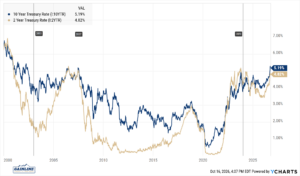
The 10-year Treasury yield rose more than 0.8 percentage points in Q3 alone, one of its largest quarterly increases in decades, according to YCharts. As of October 14, it sits at 5.19%, around where it was in 2003 and 2007. The 2-year yield, which closely tracks expectations for the Fed’s policy rate, is at 4.82% (Forbes, using U.S. Treasury data) after recently touching its highest level since May 2024 (CNBC).
Several things have pushed rates higher:
- A strong economy
- Concerns that inflation could rise
- A Federal Reserve that raised rates in September and has signaled more could come
- Worries about government spending
- The large amount of borrowing needed to build new data centers
Two recent developments could matter for where rates go from here. First, the government’s most recent sales of 10-year and 30-year bonds saw solid demand. Second, investor sentiment toward bonds has turned very negative. That might sound like bad news, but when nearly everyone feels the same way about an investment, most of the people who wanted to sell have usually already sold. In the past, that kind of lopsided sentiment has often come before a turnaround.
Bond prices and interest rates move in opposite directions, so if bond prices recover, rates would come down. Lower rates make borrowing cheaper for companies and make future profits more valuable to investors today. Both of those tend to support stock prices. And if rates do ease, it would happen during a stretch of the year that has historically been strong for stocks.
How We’re Positioning Portfolios
We don’t expect a straight line from here. Rates could stay high longer than anyone wants, and inflation is still running above where the Fed would like it. At the same time, earnings remain strong, and some of the signals we watch are starting to look more constructive heading into year-end. That’s a good balance of risk and opportunity, and we want portfolios ready for both.
Higher bond yields have a real upside for the income side of your portfolio. Bonds are paying more than they have in years, and if rates do come down, bond prices would rise. That’s part of why we see bonds playing a meaningful role right now, both as a cushion against stock market swings and as a source of income.
We’re also continuing to make sure everyone has roughly 18 to 24 months of cash needs set aside, so short-term volatility never forces a decision you don’t want to make. Beyond that, we’re staying diversified, staying patient, and putting money to work in a measured way.
The right mix is different for everyone, and it’s something we revisit as part of your plan. If you have questions or want to talk through where you stand, we’d love to hear from you.