July 2026 Market Update
The Picture of Resilience & What Comes Next
Halfway through 2026, markets have stayed resilient despite geopolitical conflict, a shifting inflation picture, and nonstop AI headlines. Gainline Financial Partners’ Charlie Barkmeier and Casey Wesson walk through what’s fueling that strength, where inflation and the Fed stand, why bonds are looking more attractive, and what midterm election years tend to mean for volatility. Watch the full conversation for what we’re watching heading into the second half of the year.
We’re halfway through 2026, and markets have remained remarkably resilient despite geopolitical conflict, a shifting inflation picture, and constant AI headlines. The S&P 500 finished the first half of the year up nearly 10%, already ahead of its long-term average annual return.
Real earnings, not just optimism
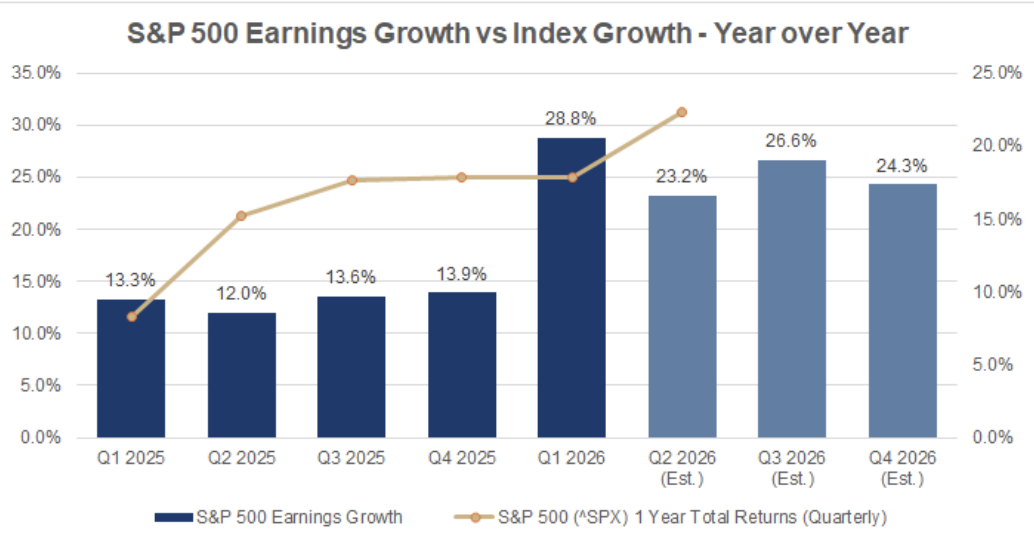
S&P 500 earnings grew nearly 30% in the first quarter compared to the same quarter last year, and analyst estimates for Q2 run in the 23 to 29% range. That growth is backed up by solid fundamentals: GDP growing above trend, unemployment holding around 4.2%, strong consumer spending, and household net worth at record levels. It’s “growth backed up by growth,” as Charlie put it.
The AI trade, and whether it’s overheating
AI infrastructure spending is massive right now, with the largest tech companies investing between $750 billion and $1 trillion this year on data centers, computing power, and networks. That’s driving a meaningful share of the profit growth we’re seeing. For context, current investment levels as a share of GDP are comparable to the electrification of the American economy, and would need to roughly double to match the railroad buildout of the 1870s and 1880s. Both looked expensive at the time and both laid the groundwork for lasting change. Growth is also broadening beyond the big tech names: small caps are up about 22% this year, and international markets have been among the stronger performers.
None of this is risk-free. Sentiment in parts of the market has gotten stretched, and any meaningful slowdown in AI spending or profit growth could ripple through quickly. The long-term demand for computing power, energy, and infrastructure looks durable, but it’s worth staying prepared for a bumpier road along the way.
Where things stand on inflation and the Fed
Headline inflation climbed to around 4% earlier this year, driven largely by an energy price spike tied to the US-Iran conflict. As tensions have eased, so has that pressure, with the most recent inflation print closer to 3.5%. Core inflation has stayed contained, and wage growth hasn’t accelerated in a way that would signal a broader feedback loop. The most likely path for the Fed right now is to hold steady through the second half of the year, watching both inflation and employment closely before making any move.
Bonds are looking more appealing
With rates higher than they’ve been in years, bonds offer more income relative to cash than they have in a long time. If you’re holding excess cash for safety, it may be worth revisiting whether some of it could be working harder for you
Midterm election years and volatility
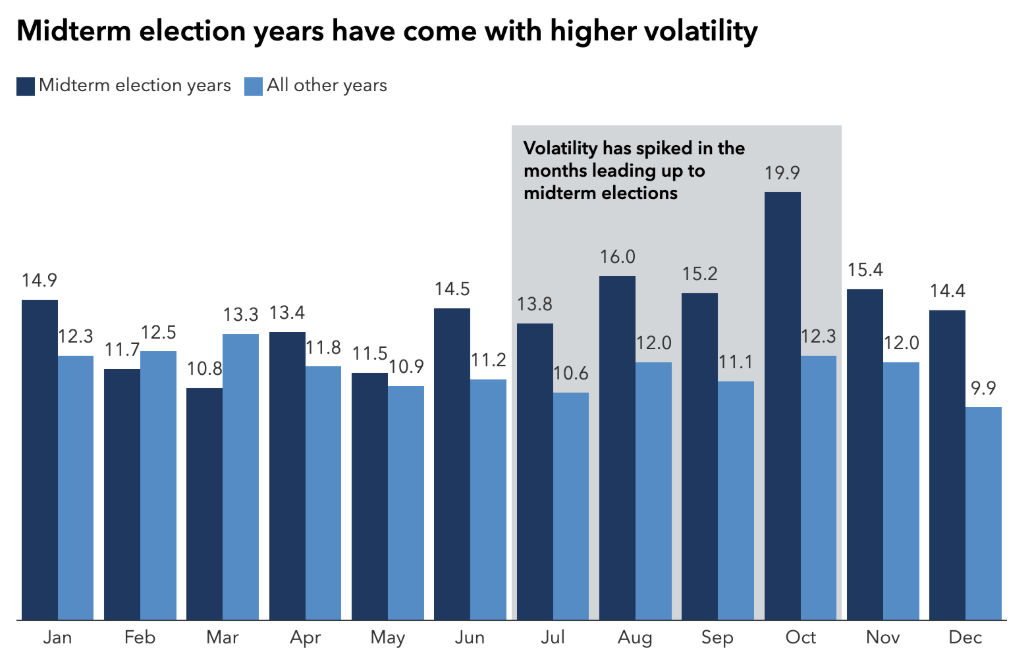
History shows midterm election years do bring more volatility, particularly in the months leading up to the election. What history also shows is that this volatility hasn’t changed long-term returns. Markets tend to dislike uncertainty more than any particular outcome, and tend to perform well once there’s clarity on who’s in charge, regardless of party.
How we’re thinking about portfolios
Staying prepared for volatility while remaining optimistic about the long term is the right approach. That means staying diversified, disciplined, and anchored to your plan rather than short-term headlines. We generally recommend keeping 18 to 24 months of expected portfolio withdrawals in cash or cash equivalents, enough to ride out volatility without having to sell at the wrong time. If it’s been a while since we’ve looked at that number together, it’s a good time to reconnect.
Questions about how any of this connects to your own plan? Reach out to your Gainline team. We’re always happy to talk it through.